Expert Tips
Exposed Wood Structure in Aquatic Centers and Pools
Durability guidance for the use of wood in aquatic environments and other areas of high humidity

The main durability consideration associated with the use of wood in environments such as pools and aquatic centers is high moisture content in the wood. Buildings such as this may have high relative humidity and it is important to understand how this affects exposed wood within that space.
In a conditioned building, wood framing will eventually settle into an equilibrium moisture content (EMC), which is a function of both the relative humidity and temperature. This is illustrated in the matrix provided in Table 4-2 of the Forest Products Laboratory’s Wood Handbook. Mold will not grow on wood when its moisture content (MC) is below 20%.* Table 4-2 of the Wood Handbook shows that, in order to have an MC in excess of 20%, conditions require relative humidity of 90% or greater, regardless of temperature.
This begs the question: What is the typical range of relative humidity in indoor aquatic centers? Guidelines for temperatures and relative humidity in natatoriums can be found in the 2019 ASHRAE Handbook – HVAC Applications, Chapter 6. This information could be used to calculate the EMC of wood framing used in such a space. The ASHRAE Handbook notes:
Like most indoor spaces, a natatorium requires year-round humidity levels between 40 and 60% for comfort, reasonable energy consumption, and building envelope protections.
To minimize evaporation and operating costs, the air temperature should be kept as warm as practical, ideally at or above the water temperature, with a maximum of 86°F db, which is generally understood to be the maximum for human comfort.
Using these ASHRAE-recommended values for natatoriums—maximum 60% relative humidity and 86°F—Table 4-2 of the Wood Handbook indicates that the EMC should not exceed 12%, which is well below the 20% threshold for decay and mold growth.
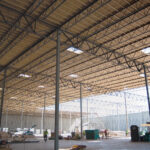
The use of exposed wood framing in indoor pools and aquatic centers is nothing new. Below are several examples of exposed timber-framed indoor pool structures:
- Jackson County Aquatic Center
- təməsew̓txʷ Aquatic and Community Center
- Dennis L. Shippey Aquatic Center
- West Vancouver Aquatic Center
- Grandview Heights Aquatic Center
- Hillcrest Aquatic Centre
- East Hants Aquatic Centre
- Guilford Aquatic Centre
*Mold & Wood Products No. 2: Preventing and Controlling Mold, Western Wood Products Association (requires free account log-in)
Photo Credit:
Dennis Shippey Aquatic Center – Pasadena, TX
cre8 Architects, Matrix Structural Engineers, Gary Zvonnkovic Photography
Related Resources
-
 Wood Structural Panel Overlays for Lumber-Sheathed Diaphragms Expert Tips
-
Shear Walls with Multiple Layers of Shear Resistance Expert Tips
-
Considerations for Setting Building-Level Benchmarks for Life Cycle Assessment Expert Tips
-
Panelized Wood Roofs: Enclosure Design for Long-Term Performance Expert Tips