Cincinnati Public Radio
Cincinnati, Ohio
- Award Year
- 2026
- Award Category
- Wood in Architecture
- Architect
- emersion DESIGN
- Structural Engineer
- Schaefer
- General Contractor
- Skanska
- Owner
- Cincinnati Public Radio
- Photos
- Ryan Kurtz Photography
Mass timber building reflects organization’s mission of transparency and accessibility
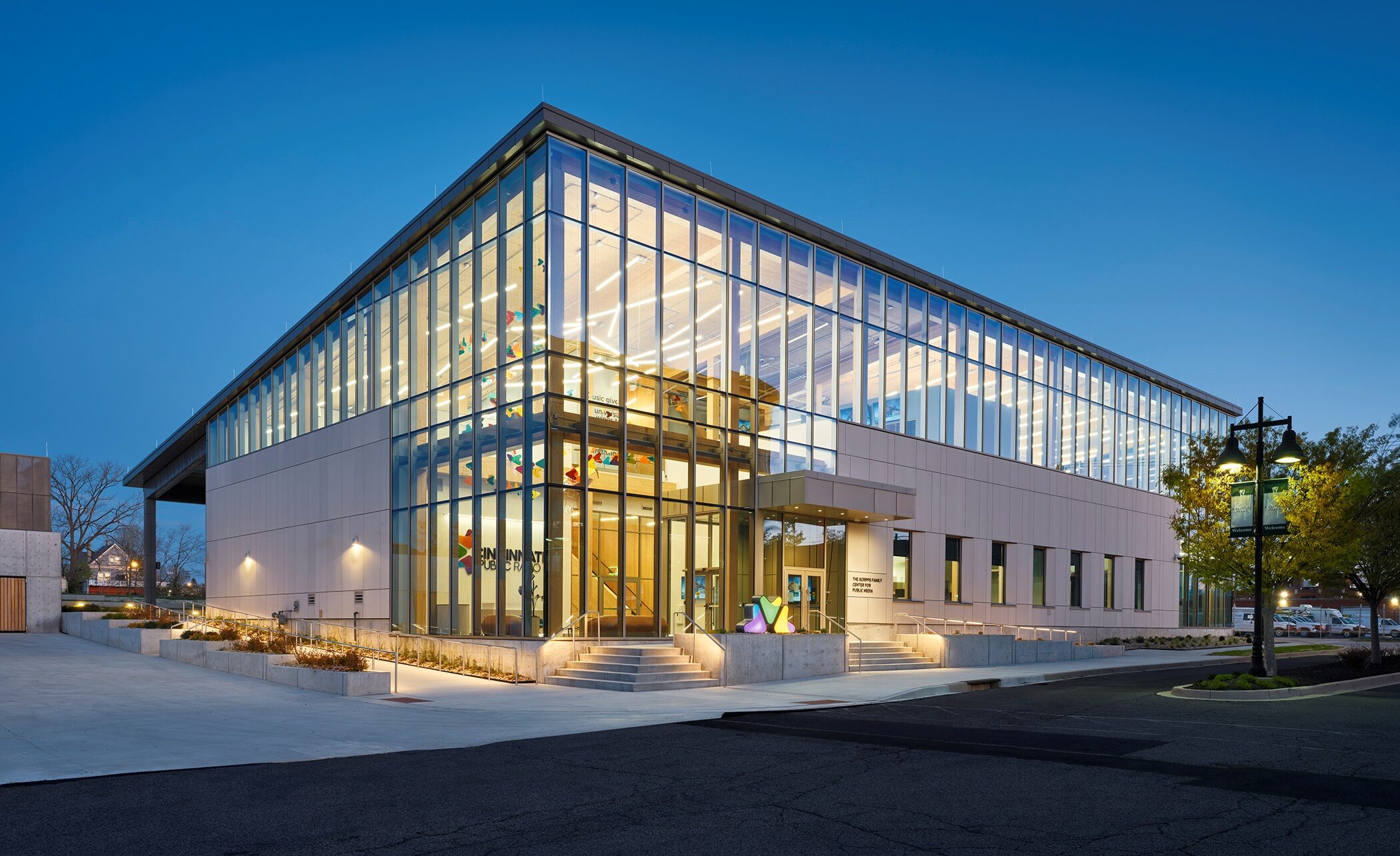
Recording and broadcast studios have historically relied on concrete and steel construction. But when Cincinnati Public Radio (CPR) needed a new home, they wanted something different—a building that met their technical requirements while reinforcing their commitment to sustainability and community. They wanted to create a “cultural living room” for the people of Cincinnati and a healthy place for employees to work. The design team chose mass timber.
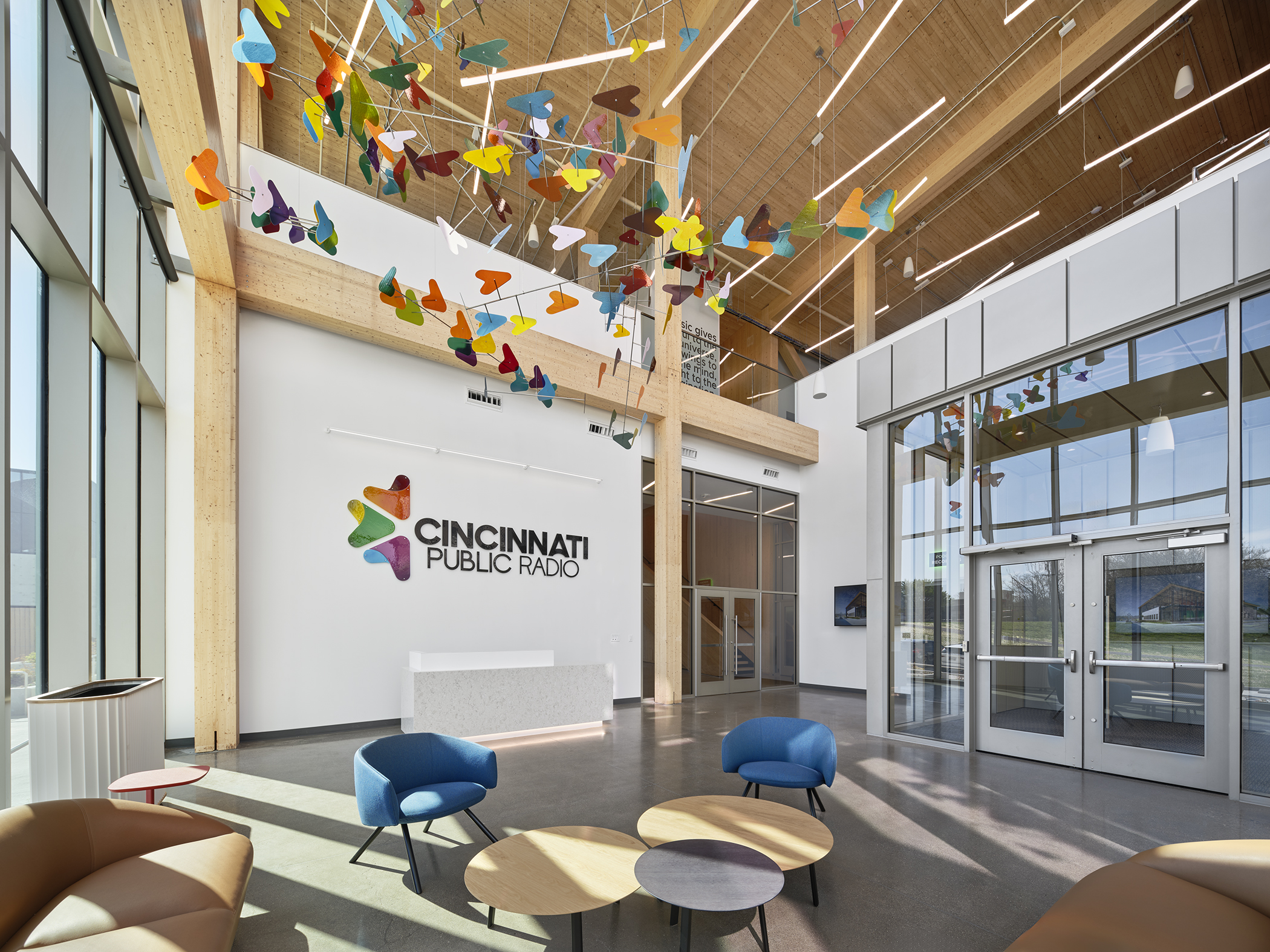
To reflect CPR’s mission of championing transparency in journalism, the two-story, 32,000-square-foot building features a glass exterior, which clearly exposes the glulam columns and beams, and CLT floors, walls, and roof panels inside. The facility includes offices and collaboration zones, a large public gathering hall with a performance stage, and specialized studio environments, including two on-air studios, two interview studios, and a large ensemble recording studio. Simple connections and strategically-positioned mass timber stairs turn core elements like CLT shear walls into sculptural features while efficiently meeting fire protection requirements.
Acoustics were a primary design driver, shaping the volume of the space, hierarchy of materials, and geometries that govern how sound is absorbed, reflected, and diffused. The team integrated numerous control strategies into the timber structure, calibrating panel depths, connection detailing, and system stiffness to minimize sound and vibration transmission. They also incorporated a radiant floor heating and cooling system that is essentially noiseless. The decision gives the space a warm and intimate acoustic signature, and the absence of ductwork leaves visual focus on the exposed wood interiors.

The project’s sustainability strategy prioritized mass timber as the primary material in the Type V-B structure, avoiding the need for additional finish materials. The radiant heating and cooling system also contributed improved energy efficiency and enhanced indoor air quality through reduced air movement and fewer particulates. The system was easy to install via a topping slab over the CLT floor panels. In addition, the building envelope was exceptionally airtight, which also helps maintain moisture and humidity levels.
Efficient assembly also added value. The mass timber structure was erected in just 37 days during winter, substantially reducing overall construction duration. Even with the quick installation, the project team implemented a comprehensive moisture strategy to protect the wood during construction.
As the first mass timber broadcast facility in the U.S. and the first multi-story mass timber building in Cincinnati, this project demonstrates the scalability and technical viability of wood in building types traditionally dominated by concrete and steel. The structure proves that mass timber can meet complex acoustical and vibration requirements while also delivering a sustainable, cost-competitive, and aesthetically distinguished building solution that welcomes an entire community.
“Cincinnati Public Radio’s new headquarters demonstrates how mass timber can elevate design excellence while meeting demanding functional needs. This project is a market differentiator in form and function, reflecting design ingenuity while meeting the client’s mission of authenticity, warmth, and community connection.”
Adam Luginbill, RA, NCARB, LEED AP, Project Architect, emersion DESIGN


-

1040 W. Fulton
Hartshorne Plunkard Architecture / photo Danny Carpenter -
111 East Grand
Neumann Monson Architects / Photo Mike Sinclair -
T3 Minneapolis
MGA | Michael Green Architecture, DLR Group / Photo Ema Peter; MGA
Similar Projects
Each year, our national award program celebrates innovation in wood building design. Take inspiration from the stunning versatility of buildings from all over the U.S.