Case Studies
The Village at Mines Park
University combines light-frame wood and mass timber for affordable student housing
When this premier engineering and applied science university combined mass timber with light-frame wood to build affordable student housing, they overcame many of the challenges common to this type of project, including budget constraints, strict timelines, and high student expectations. And they did so while meeting their own goals for sustainable design.

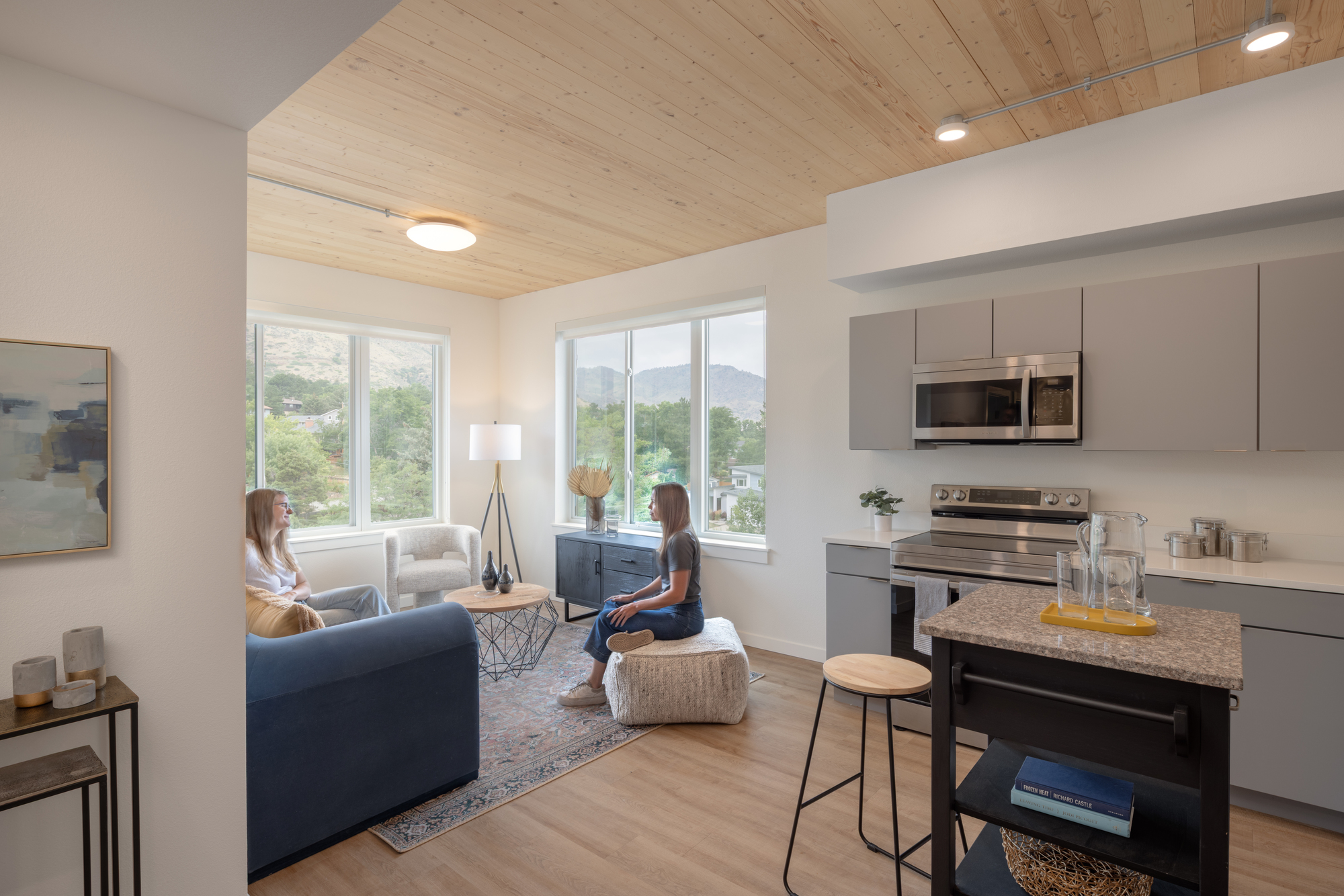
Photo Kyla Chambers
Like many universities, the Colorado School of Mines needed more beds. The housing near campus was well-situated but dated and inefficient. To maximize the prime location, Mines demolished six of the most underutilized structures, which housed less than 100 students, and replaced them with five new multi-story buildings. Today, the redevelopment known as The Village at Mines Park provides attractive, convenient, affordable housing for more than 650 students.
The University had ambitious sustainability goals, budget constraints, and a strict schedule, but the land itself was problematic. “The site has about a 50-foot grade change from top to bottom,” said Matthew Breen, Architect and Project Manager at SAR+ Architects. “So, we were truly designing these buildings to fit on the side of a mountain. And the result is a much better use of the land from a density standpoint.”
The new structures were built using a mix of light-frame wood and mass timber. The hybrid configuration took advantage of many of the positive aspects of wood construction, overcoming cost, schedule, and structural challenges while giving students a beautiful place to live.
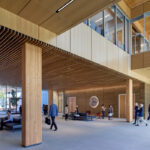
“You can see the excitement when people experience these buildings for the first time. Most people don’t expect to see beautiful wood like this in student housing, and it’s a pleasant surprise for them. We also know how natural materials like wood promote better learning, so that was also a key driver in our design.”
– Matthew Breen, SAR+ Architects
Making it Pencil
The Village at Mines Park was developed through a public-private partnership (P3) led by Capstone Development Partners. “They gave us key requirements in terms of how many units were needed to make the project pencil,” said Breen. “Our budget was set from day one.”
The initial plan was for five light-frame wood structures, using engineered wood trusses for the floors and roofs. But shortly after beginning design, SAR+ discovered that the City of Golden had a 50-foot height limit along the north edge of the property, where four of the five buildings would be located. This meant they had to re-examine the structural system, since the planned five-story buildings exceeded the height requirements.
The team considered all-concrete options as well as one that combines a composite floor system with pre-panelized load-bearing metal stud walls. But both Mines and Capstone Development Partners required a certain baseline of sustainability, so the design team continued to pursue a wood system. SAR+ and Milender White Construction were both familiar with cross-laminated timber (CLT) and together determined that the shallow floor and roof assemblies allowed by the mass timber panels would enable them to keep the buildings under 50 feet.
Four of the student residences were designed using the mass timber/light-frame hybrid system. Three are five stories and the fourth, built into a slope, is four stories to better match the massing and scale of the others. The fifth building has four stories of light-frame wood over a concrete podium, as it is outside the height-restricted area.
To keep reading, download the free case study.