
- This event has passed.
Mass Timber Acoustic Design: Variables and Solutions
September 9 @ 1:00 pm - 2:00 pm EDT
- Online
Mass Timber Acoustic Design: Variables and Solutions
Mass timber construction is often perceived as acoustically inferior to conventional construction types, particularly in multi-family buildings subject to code-mandated sound transmission requirements. These perceptions often lead to design approaches that increase assembly mass—most commonly by adding concrete toppings, which can diminish the embodied carbon benefits of mass timber systems. This course evaluates the validity of these assumptions through a review of measured baseline acoustical performance data for mass timber assemblies and comparisons with conventional construction types. The presentation introduces the principles of sound transmission and isolation to provide a framework for understanding acoustical behavior in building assemblies, followed by an examination of design and construction strategies for improving airborne and structure-borne sound isolation in mass timber floors and walls. The presentation will also cover acoustic flanking and how it relates to mass timber construction. Participants will gain insight into informed decision-making strategies that balance performance, constructability, and sustainability.
Credits: Attendees can earn 1.0 AIA/CES HSW LU, 1.0 PDH credit or 0.10 ICC credit
Bonus content: Attendees are invited to stay on after the webinar for a non-accredited bonus session featuring WoodWorks Partner Mercer Mass Timber for a manufacturer Q&A.
Speaker:

Mike Raley | Director, Oregon Acoustic Research Laboratory
Mike Raley is an acoustician with more than 17 years of experience in architectural acoustics, specializing in laboratory testing of building assemblies. His work focuses on measuring and improving sound isolation in floors, walls, and ceiling systems, helping translate laboratory data into practical design guidance for architects, engineers, and manufacturers. Mike has played a leading role in advancing acoustical testing standards and interlaboratory research. He currently serves as co-chair of interlaboratory studies for ASTM E90 (STC) and ASTM E492 (IIC), coordinating accredited laboratories across the United States and Canada to improve the reliability and consistency of sound transmission loss measurements. His work emphasizes rigorous testing methods, representative assemblies, and stronger links between laboratory results and real-world building performance. In addition to his technical work, Mike is active in industry education and collaboration. He regularly develops webinars and continuing-education courses for design professionals and works with manufacturers and research organizations to expand the knowledge base around building acoustics and sound isolation performance.
Learning Objectives:
- Compare the baseline airborne and structure-borne sound isolation performance of mass timber assemblies.
- Compare the measured acoustical performance of mass timber assemblies with conventional construction systems and evaluate common assumptions regarding code compliance and occupant comfort.
- Evaluate the performance, constructability, and sustainability tradeoffs associated with common acoustical design decisions.
- Differentiate between design approaches that rely on increased assembly mass and those that improve acoustical performance through targeted detailing, and evaluate their implications for occupant welfare, sustainability, and project outcomes.
Online Attendees:
- WoodWorks will send each attendee a certificate of completion within 2 weeks via email.
- Please note that to receive a certificate, attendees must stay for the duration of the event.
For questions or additional information, please contact:
Jaime Krohn, CMP | jaime@woodworks.org | (312) 841-8272
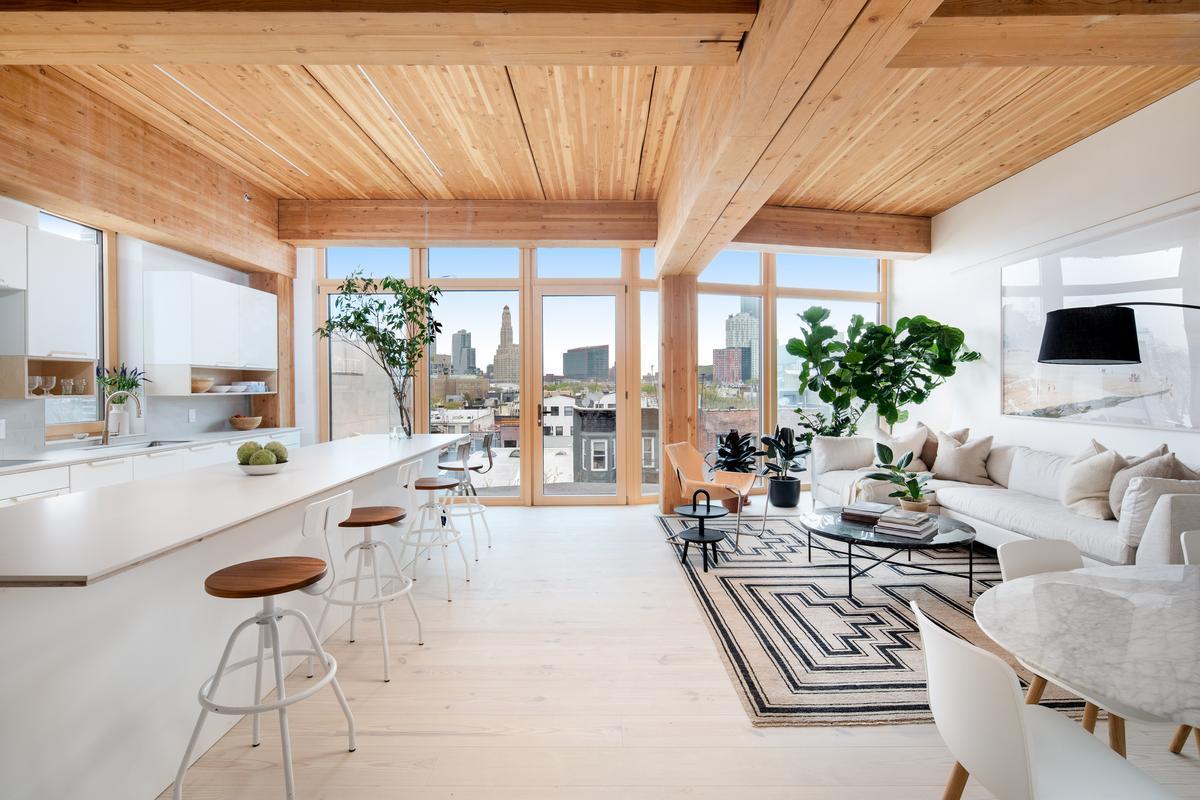
Image: Timber House / MESH Architectures / Photo Travis Mark