Case Studies
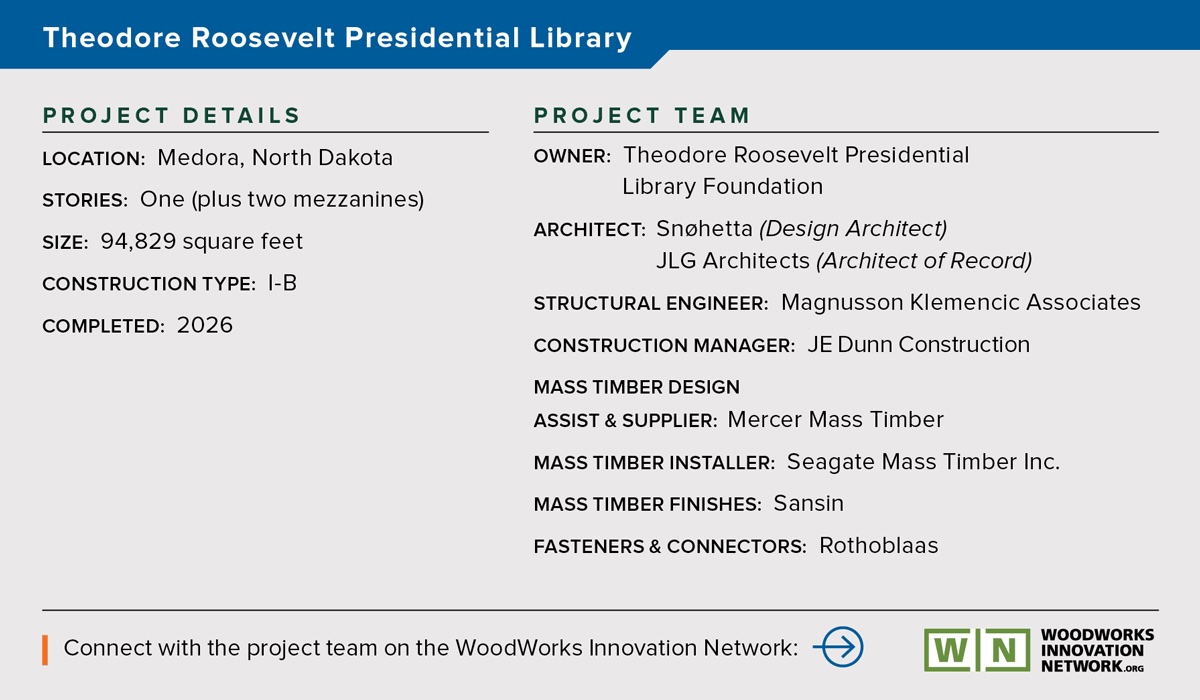
Theodore Roosevelt Presidential Library
Modern mass timber hybrid honors former president’s conservation ethic
Rising from the rolling hills of the North Dakota Badlands, this unique library was designed to embody the conservation legacy of Former President Theodore Roosevelt. The rugged and remote location, on top of a grassy butte across from Theodore Roosevelt National Park and hours from any city, is a natural part of its draw.

“We first arrived on site in spring 2020, and once our team fully processed the awe of the Badlands landscape, we tried to wrap our minds around how we could create a building that was grounded in this place,” said Aaron Dorf, Director and Architect at Snøhetta. “We wanted to give visitors an experience they couldn’t get anywhere else.”
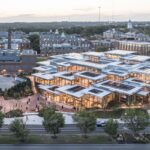
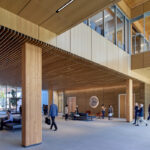
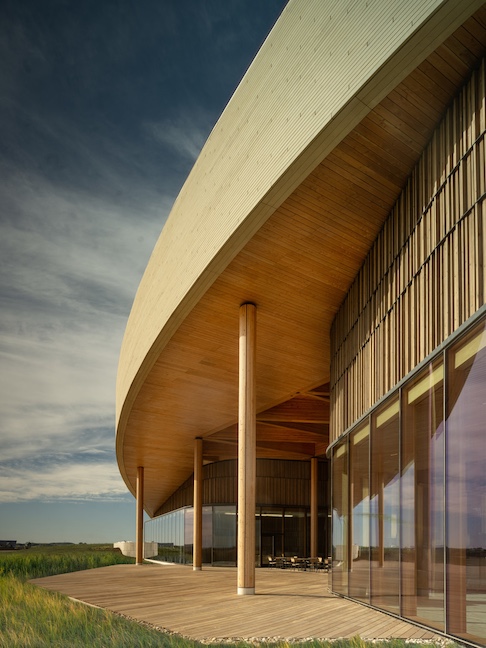
To honor Roosevelt’s environmental values, the building, one of just 17 presidential libraries in America, features glulam beams and cross-laminated timber, rammed earth walls, and one of the largest native green roofs in the country. Its sculptural shape helps the building almost disappear into the surrounding prairie, meeting the design goal of creating architectural harmony using natural materials.
Sustainable Design Reflects Roosevelt’s Influences
Roosevelt once said that if it weren’t for his time in North Dakota, he never would have become president. The northern plains state was a formative place for him, a place of rebirth where he escaped to grieve after both his mother and his wife died on the same day in New York City. While Roosevelt was considered somewhat of an aristocrat when he left New York, he eventually became known as an outspoken Western figure—part hunter, part cowboy, part soldier, and eventually, full-time politician.
His life in the West gave him deep respect for the environment. During his presidency, from 1901 to 1909, Roosevelt created the U.S. Forest Service and established over 200 national forests and federal bird reserves, protecting more than 200 million acres of public land.
Both Snøhetta and JLG Architects were challenged by how to design a project dedicated to someone who is considered by many to be ‘the conservation president,’ so they began with a design that is deeply rooted in Roosevelt’s environmental beliefs. The Theodore Roosevelt Presidential Library is designed to meet the requirements of three ambitious building certifications: Living Building Challenge v4.0 – Full Certification, LEED BD+C v4.1 Platinum, and SITES v2 Platinum.
“Our design goals centered on what we called the Four Zero approach: zero carbon, zero energy, zero water, and zero waste,” said Dorf. “Sourcing the mass timber became an important part of this goal, since the Living Building Challenge has strict guidelines with respect to material sourcing. So, wood was a critical character-defining element from the beginning.”
The Landscape is the Library
The building’s structural shape came about through what Dorf calls “a happy accident.” He said they were playing with natural elements found in the landscape, and the idea came from two pebbles covered by a leaf, which led to the concept. The resulting silhouette intentionally blurs the line between building and landscape to reflect the impact that North Dakota had on Roosevelt, with a building that seems to disappear into the surrounding prairie. The walkable living roof supports almost 2 feet of soil and native grass plantings, contributing to the project’s sustainability goals. The roof gives visitors expansive views across the 93-acre site and serves as an ideal location for nighttime stargazing.
“I think people will be surprised to learn that wood buildings don’t need to be simply shaped. This Library has hundreds of unique connections, and a building shape in which nothing is plumb or level. Yet we were able to pull that off, with a great deal of precision, proving that beautiful, complex buildings can be made with wood.”
– Beau LaCroix, Project Architect at JLG Architects
“We couldn’t imagine a typical building in this landscape,” said Dorf. “Our goal was to create a building that looked like a part of the landscape, and then we tucked spaces within it. The outline of the earth-covered roof, which itself is both architecture and landscape simultaneously, is a visual echo of the three-quarter-mile boardwalk that loops around the site. The experience of the land is an integral part of the experience of this presidential library, every bit as important as going in to see exhibits or an event in the auditorium.”
The library itself also brings the landscape inside. Rammed earth feature walls, designed to reflect the layered colors of the Badlands, flank the main lobby. Seating, the ticketing desk, and other furniture were custom-built with reclaimed wood.
“Years ago, caretakers had to take down an old copper beech tree at the President’s home at Sagamore Hill on Long Island,” said Dorf. “It was a sapling that TR had planted. The family kept the wood, and those boards now form the surface of the ticketing desks, giving people a direct, tactile connection to Roosevelt himself.”
To keep reading, download the free case study.