Expert Tips
Fire-Resistance Requirements for Lateral Framing
Guidance for determining whether timber members used as part of a building’s lateral force-resisting system require a fire-resistance rating
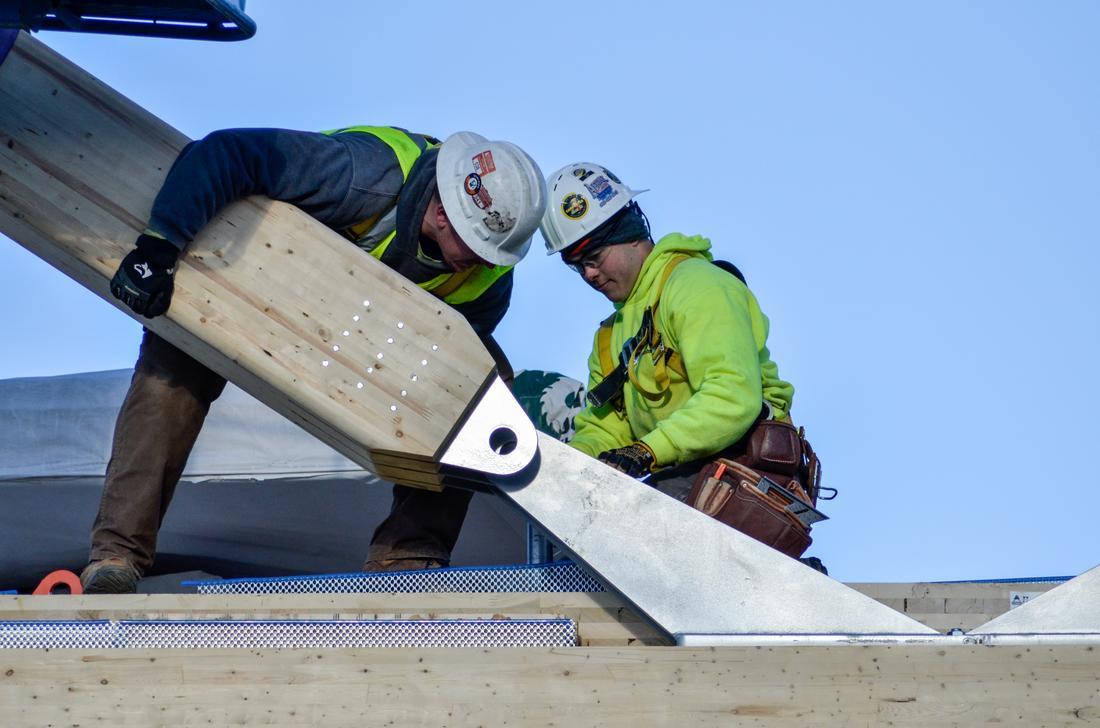
Credit: Alex Schreyer
This article references the 2024 International Building Code.
In both light frame wood and mass timber construction, it is common to use wood framing to support both gravity and lateral (wind or seismic) loads. However, some members are only subject to lateral loads. As described below, only framing members supporting gravity loads are required to achieve a fire-resistance rating (FRR).
IBC Table 601 provides required FRRs for various structural members and assemblies. Some assemblies will perform dual structural functions. For example, an interior load-bearing wall in a Type III-A building requires a 1-hour fire-resistance rating per Table 601. That same wall may also function as a shear wall, but no FRR requirements for shear walls are presented. A diagonal glulam brace, on the other hand, which only supports lateral loads and not gravity loads, does not have a direct reference in Table 601.
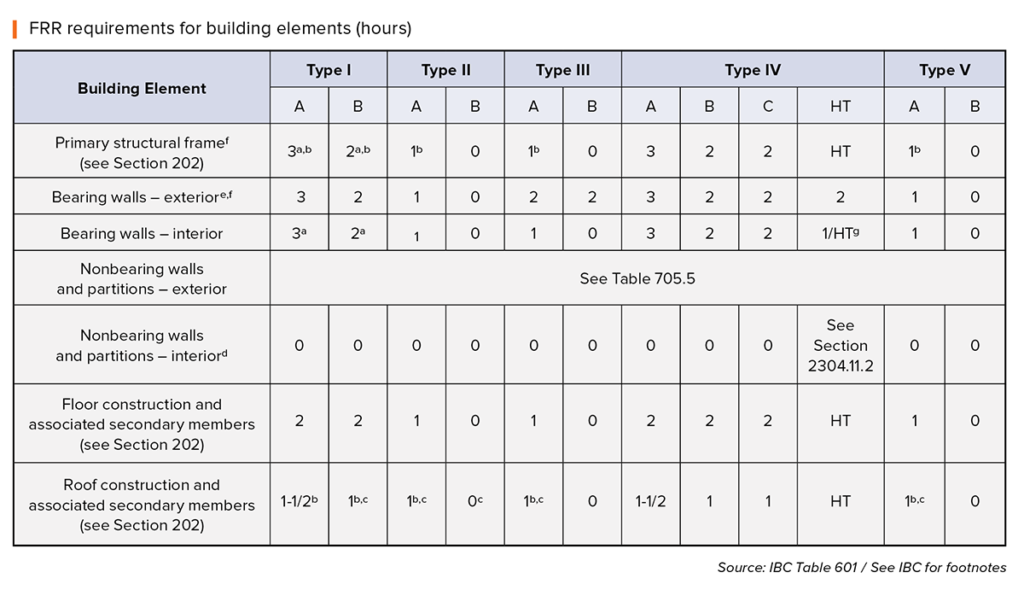
A common question is whether this type of diagonal brace counts as a primary structural frame element, with a required FRR from Table 601. The definition of primary structural frame in Section 202 indicates that it is applicable to gravity-supporting members only:
PRIMARY STRUCTURAL FRAME. The primary structural frame shall include all of the following structural members:
- The columns.
- Structural members having direct connections to the columns, including girders, beams, trusses and spandrels.
- Members of the floor construction and roof construction having direct connections to the columns.
- Members that are essential to the vertical stability of the primary structural frame under gravity loading.
Item 2 might seem to indicate that a bracing element is part of the primary frame, but item 4 is clear that the designation of primary structural frame applies only to elements providing vertical stability under gravity loading. No reference to lateral loading is indicated. The code commentary in Chapter 2 further clarifies that the definition of primary structural frame applies only to gravity load-carrying elements:
The primary structural frame and secondary members must meet different standards of design and protection as specified in Chapters 6 and 7. The definitions of these two terms spell out which elements of a structure’s framing system are part of the primary structural framing system essential to carrying the gravity loads of the building. Such elements are generally required to have greater fire-resistance protection.
The code commentary to Table 601 further reinforces the applicability of this table to gravity-only members:
Any structural item that provides direct connections to columns and bracing members that are designed to carry a gravity load are considered part of the structural frame. To delay vertical (i.e., gravity) load-carrying collapse of a building due to fire exposure for a theoretical amount of time, the components that make up the primary structural frame are required to maintain a minimum degree of fire resistance.
Depending on the structural usage, bracing for a gravity member may have a different fire-resistive rating than the gravity member, or have no rating at all. For example, 2-hr FRR exterior load-bearing walls are required in Type III-A construction. Bracing for the load-bearing wall is usually provided by the floor assembly, which is only required to have a 1-hr FRR.
For more information on fire design of gravity members, see the Woodworks’ paper: Fire Design of Mass Timber Structural Members.
While this article is primarily focused on the FRR requirements of Table 601 for various structural elements, the IBC contains other FRR provisions for elements and assemblies serving specific functions. A few common examples are fire-rated walls and floor-ceiling assemblies used as occupancy separations, dwelling unit separations in multi-family residential, and shaft enclosures. When lateral structural elements are part of those assemblies, additional FRR requirements may apply.