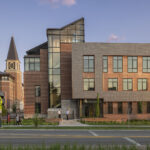
Bush Middle School Whole Building Life Cycle Assessment
Compares a Type V-B mass timber building and a Type V-B steel building with a primary focus on embodied carbon

 Need Project Support?
Research
Compares a Type V-B mass timber building and a Type V-B steel building with a primary focus on embodied carbon
The purpose of this study is to assess the Bush Middle School building, located in Seattle, Washington, to understand the potential environmental impacts of a Type V-B mass timber structure compared to a functionally equivalent Type V-B steel structure using whole building life cycle assessment (WBLCA) with a primary focus on embodied carbon. The results are intended to provide further understanding of the impacts of wood construction.
Bush Middle School consists of a two-level mass timber-framed structure, a portion of which sits on a steel podium above the partial basement level. The entire structure is supported by a shallow spread footing foundation. The building is Type V-B construction and contains classrooms, administrative offices, workrooms, study lounge, storage rooms, and a kitchen. It is approximately 25,725 gross ft2 (2,390 m2). The building is located in Site Class D, is governed by seismic forces, and falls into Seismic Design Category D.
The owner is The Bush School and Bloom Projects is their representative. Mithun is the project architect, DCI Engineers is the Structural Engineer of Record, and Venture General Contracting is the contractor. During the schematic design phase, the project team explored both composite steel framing and mass timber framing above the partial steel podium. They noted that the main drivers for choosing mass timber were its inherent sustainability, occupant health benefits of biophilic design, and the pursuit of net-zero carbon and Salmon-Safe certification.
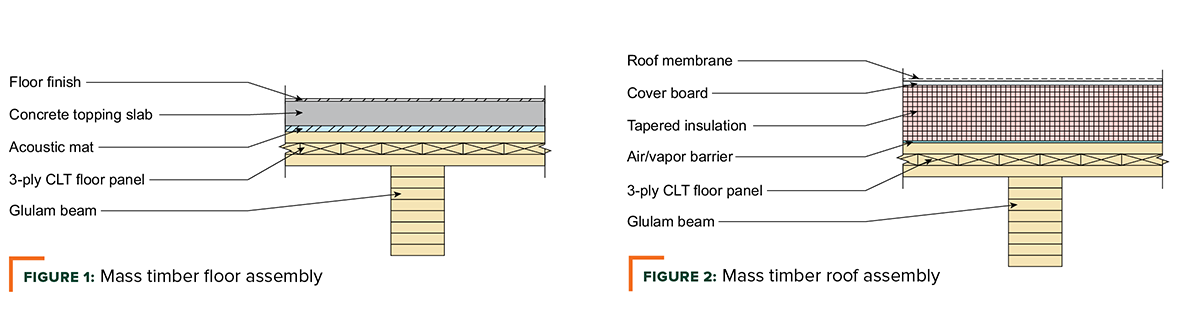
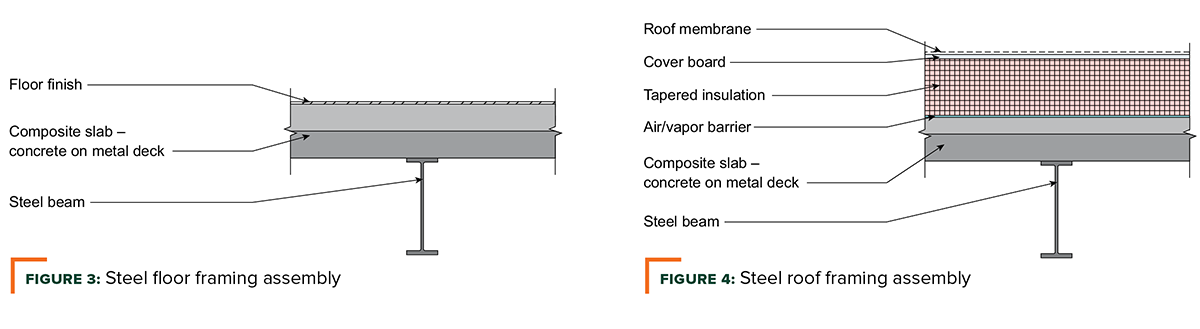
The structural systems compared in this study were the mass timber design as noted and a full composite steel system with a partial below-grade portion. Both options utilized buckling-restrained brace frames (BRBF) to resist lateral forces. Foundations for both consisted of concrete slab on grade, spread footings at column and BRBF locations, and concrete basement walls to retain soil at the partial below-grade portion.
For the mass timber building, drawings and associated Revit models, both structural and architectural, were used in the analysis; structural design and development of a Revit model for the alternative building was performed for the purposes of this WBLCA. Both the mass timber and steel building LCAs were undertaken at the design development phase.
The two designs are considered functionally equivalent and account for appropriate construction type, fire protection measures, acoustic performance, thermal performance, and programming. The structural design for each material system was also optimized and adjustments to building height, weight, and the lateral system are accounted for as necessary.
Download the study to compare GWP contributions of the total buildings (structure and enclosure), above-podium structural systems, and structural and architectural components, as well as biogenic carbon and other impact categories.
Authors: This study was developed collaboratively by DCI Engineers and WoodWorks.