Expert Tips
Occupiable Roof Decks and Allowable Building Size
Discusses whether rooftop decks are considered a separate story, and how occupancy and area contribute when evaluating height and area requirements
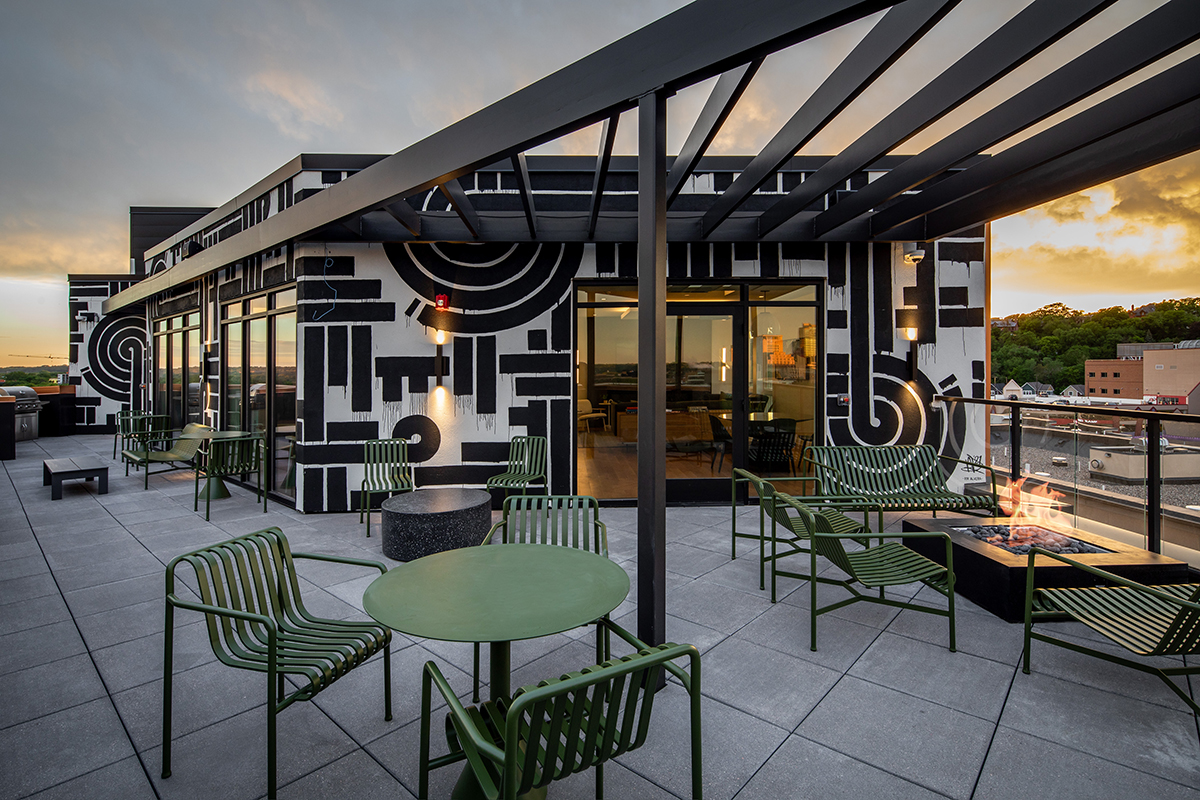
Photo Korey Kevin Studio
Unless otherwise noted, this article references the 2024 International Building Code (IBC).
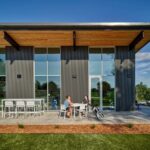
Occupiable roofs are becoming more common as outdoor amenity spaces, offering fresh air and views, and increasing overall marketability of the properties. In most instances, these roof decks are open air, without roof coverings, and have partial-height guards or parapet walls around their perimeter. Designers often wonder whether roof decks of this kind need to be included when calculating required construction type, building area, and number of stories.
Section 503.1.4 clarifies that if the occupancy of the roof is also permitted for the story immediately below the roof, it does not need to be included in the building area regulated by Section 506 nor the building height and number of stories regulated by Section 504. Further, if the building is fully equipped with an NFPA 13 or NFPA 13R sprinkler system and an occupant notification system in accordance with Section 907.5, the roof occupancy is not restricted to the occupancy of the story below. The commentary clarifies:
The code defines a story as “that portion of a building included between the upper surface of a floor and the upper surface of the floor or roof next above.” An uncovered roof deck is clearly not a story, because there is no floor or roof above.
This section also exempts the area of an occupiable roof from being part of the area of the building. Building area is also a function of story. No story, no building area.
Although uncovered and not considered a separate story for the purpose of building area and high-rise provisions, occupiable roofs do have associated fire and life safety requirements. IBC Section 1006.3 lists egress requirements and Section 903.2.1.6 lists sprinkler requirements for assembly occupancies on roofs. An automatic sprinkler system (either NFPA 13 or NFPA 13R where permitted) is required on all stories between the occupied roof and level of exit discharge when one of the following conditions exist:
- Group A-2 occupied roofs with an occupant load greater than 100
- Other Group A occupancies with an occupant load greater than 300
Code Evolution of Roof Decks
Code language regarding this topic has evolved over the past several code cycles. Under the 2012 and 2015 IBC, some felt that the relevant code provisions left room for interpretation. As such, design teams working under these code editions may choose to consult with the Authority Having Jurisdiction (AHJ) to understand what is acceptable. Significant clarification was added to the 2018 IBC, with Section 503.1.4 specifically addressing whether roof decks are included in the building area calculation. New language was also added in Section 302.1 to address rooftop occupancies. The 2021 IBC further expanded Section 503.1.4 to explicitly address allowable building height and number of stories considerations. The 2024 IBC maintains the intent of 2021 code language regarding roof decks, but with a few changes for clarification and consistency. Notably, the code now refers to these spaces as occupiable roofs rather than occupied roofs and includes a definition of these spaces in Section 202.
Roof Decks with Roof Covering
Sometimes an occupiable roof deck will be enclosed with full-height walls and/or a roof covering. This is addressed in Section 503.1.4.1, which states that elements or structures enclosing the occupied roof space shall not extend more than 48 inches above the surface of the occupied roof. This height limit is primarily intended to ensure the fire department still has adequate ladder access to the roof. Exceptions are made for penthouses, towers, domes, spires, and cupolas, as well as buildings taller than 75 feet. Because buildings taller than 75 feet are generally considered beyond the reach of fire department ladders and must provide other means of fire department access, the 48-inch limit is no longer necessary.
Further, Section 503.1.4 notes that any penthouses or other enclosed rooftop structures must comply with Section 1511. While penthouses are defined as being unoccupiable (e.g., for mechanical equipment storage), rooftop structures have no such limitation. Per Section 1511.1.1, the aggregate area of rooftop penthouses and other enclosed rooftop structures cannot exceed one-third the area of the supporting roof. Beyond this limit, roof areas enclosed within rooftop structures or penthouses would be considered an additional story and would need to be included in building height and area calculations.
For individual rooftop elements, additional code provisions may apply. While not an exhaustive list, some common roof deck features include raised-deck systems (Section 1511.9), canopies and awnings (Section 3015), guards (Section 1015), and fences and mechanical equipment screens (Section 1511.6).
Whether open or enclosed, rooftop areas can potentially take advantage of the small assembly space provisions of IBC Section 303.1.2, which could be used to classify the occupied roof space as Group B, provided the limitations of that section are met. The advantage of utilizing this section is that Group B occupancies typically permit more stories than group A-2 occupancies. For more information on accessory occupancies and small assembly spaces, see the WoodWorks article, Mixed-Use Code Strategies Part 1: Incidental Uses, Accessory Occupancies, and Small Spaces.