Expert Tips
Code Path and Requirements for Mid-Rise Podium Projects
Discusses common configurations for podium buildings under IBC Section 510.2, including allowable number of podium stories, construction type, horizontal separation, and additional resources.
This article references the 2024 IBC.
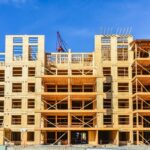
Podium construction—also known as pedestal or platform construction—is not defined in the IBC but typically refers to the special provisions of Section 510.2, since the commentary to this section is where this term first appears. This provision is often used in mid-rise construction to allow for multiple stories of light-frame wood over a single- or multi-story podium of another construction style. Common configurations include four or five stories of residential use over parking, retail, commercial, and/or office, and six or even seven stories of residential use, including the podium level(s), with subterranean parking. This construction approach allows increased density with additional stories, maximizing the use of smaller urban lots while benefitting from wood-frame cost and speed of construction advantages. While this article focuses on the use of podiums in mid-rise, light-frame construction, podiums can also be used in tall wood buildings, as outlined in this article.
Concrete podiums are the most common, though steel podiums also exist. While not covered by the provisions of Section 510.2, using a heavy timber system to separate parking from light-frame wood residential units above is also gaining popularity. More information on the options available for using heavy timber in this application can be found in Incorporating Parking Areas in Mixed-Use Wood-Frame Buildings. The remainder of this article will focus on the provisions of Section 510.2, assuming a concrete podium.
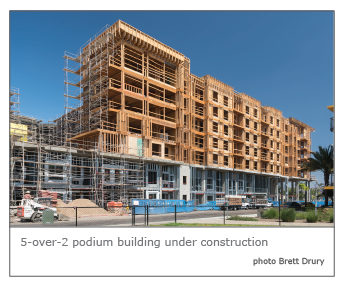
Generally, buildings must be classified as a single construction type, defined in IBC Chapter 6. However, podium structures are a product of the horizontal building separation provision (Section 510.2), one of several “special provisions” allowing a mix of construction types within a single building. Separated by a 3-hour fire resistance-rated (FRR) horizontal assembly, these ‘four-over-one’ or ‘five-over-two’ podium-style buildings are treated in the code as two separate structures built one on top of the other for the purpose of determining area limitations, fire wall continuity, allowable number of stories, and construction type.
Mid-rise, light-frame wood construction generally falls under construction Types III and V. In multi-family occupancies, a Type III-A or III-B building can include five stories of wood framing while Type V-A can include four stories of wood framing. Type IV construction can also be used for mid-rise structures.
Per the requirements of Section 510.2, the podium must be of Type I-A construction. It also must be equipped throughout with an NFPA 13 sprinkler system. The top of the podium must consist of a 3-hour FRR horizontal assembly and all elevator and stair shafts through that assembly must have a 2-hour FRR. Occupancies permitted above the podium include A, B, M, R or S, while all occupancies except H are permitted below the podium.
When these conditions are met, the upper and lower portions can be considered as separate and distinct buildings for the purposes of determining the allowable building area and number of stories. However, the overall height (in feet) of the two buildings together is measured from grade plane. Beginning with the 2015 IBC edition, podiums may include two or more stories below the 3-hour horizontal fire assembly with the caveat that the overall building height above grade (from grade plane to the average of the highest roof plane) must still not exceed the limits set in Chapter 5 for the more restrictive of the two buildings. Most often, it is the maximum allowable height of the construction type for the upper portion (Type V or Type III) that sets the overall building height.
This WoodWorks case study features 1430 Q in Sacramento, CA, which exceeded those prescriptive height limits via an alternative means and methods request (AMMR) that was approved by the Authority Having Jurisdiction (AHJ). For additional information on the AMMR process, see this WoodWorks publication or reach out to your local Regional Director.
For more detailed information on the design of podium structures, see the Five-Story Light-Frame Wood Over Podium Design Example.