Expert Tips
Using Char Methods to Demonstrate Fire Resistance of Exposed Wood Members
How to calculate the fire resistance of exposed wood members using char rates in the NDS.
This article references the 2024 IBC and the 2024 NDS.
Per IBC Sections 703.2 and 703.3, there are multiple ways to demonstrate fire-resistance ratings of structural members and assemblies. One method noted in Section 703.3 is to calculate the rating in accordance with IBC Section 722.
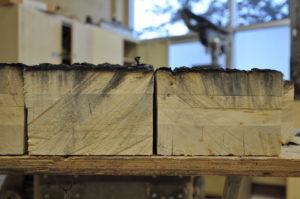
For calculated fire resistance of exposed wood members, IBC Section 722.1 references Chapter 16 of the American Wood Council’s National Design Specification® (NDS®) for Wood Construction. This chapter gives a nominal char rate of 1.5 inches of wood thickness per hour of fire resistance. Using the calculations and information contained in NDS Chapter 16, a fire rating of up to 2 hours can be calculated.
The NDS allows calculated fire resistance of a number of wood products, including solid sawn lumber (this includes nail laminated timber), glue-laminated timber (glulam), laminated veneer lumber (LVL), parallel strand lumber (PSL), laminated strand lumber (LSL), and cross laminated timber (CLT). For structural members the fire-resistance calculations use an effective char depth, which is greater than the nominal char depth. The effective char depth for structural calculations includes both the calculated char depth and a heat-affected zone in front of the uncharred wood with zero assumed strength. For non-structural members such as blocking, the nominal char depth is used. Design considerations for certain structural members such as glulam beams, timber decking and CLT are presented in NDS Chapter 16. Adjustment factors applied to the allowable design properties of structural members rated for fire resistance are also presented in this chapter.
Provisions for calculating thermal separation, avoidance of burn-through, and protection provided by applied materials, are found in the American Wood Council’s Fire Design Specification for Wood Construction.
AWC’s Technical Report 10 provides background information for the established methods in the NDS, which can help both the designer and the Authority Having Jurisdiction in applying and evaluating this method. TR 10 also includes a number of design examples for exposed structural wood members utilizing the provisions of NDS Chapter 16.
For further information on demonstrating fire resistance of structural wood members, see Fire Design of Mass Timber Structural Members: Demonstrating Fire-Resistance Ratings of Mass Timber Products.