Solution Papers
Designing with Wood Under the IBC: Construction Types, Building Size, and Fire Resistance
Explores the interconnection between allowable building size, construction type, occupancy, FRRs, and other fire and life safety requirements in the design of wood buildings
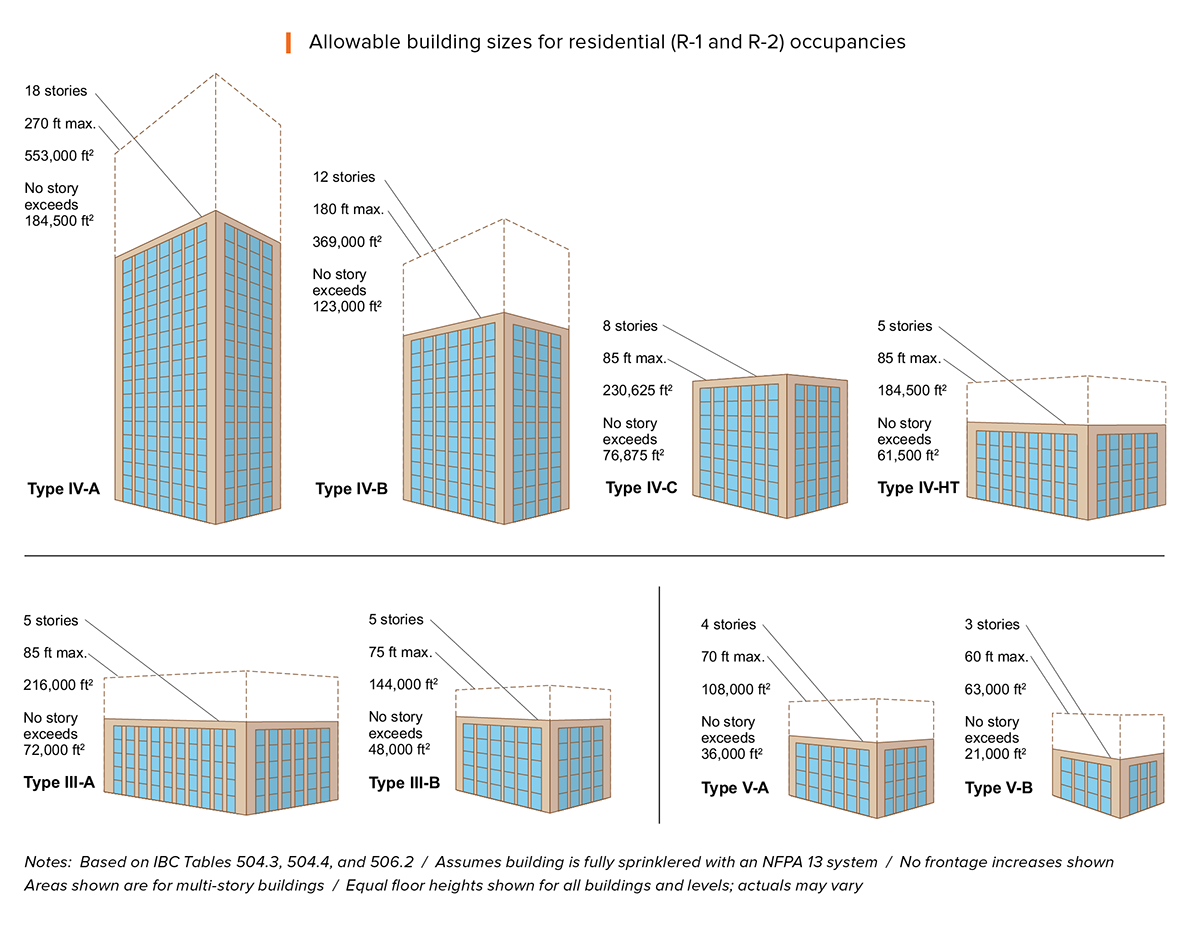
Understanding the interdependence of construction types, allowable building sizes, and fire-resistance ratings (FRRs) is key to optimizing the design of a building. Construction types dictate the materials that are permitted and provide many of the FRR requirements that apply to different building elements. In combination with building occupancy and the presence and type of sprinklers, they also dictate the allowable building size in terms of height, number of stories, and floor area. This paper introduces these concepts, giving designers a foundation for making informed decisions about where wood can be used.

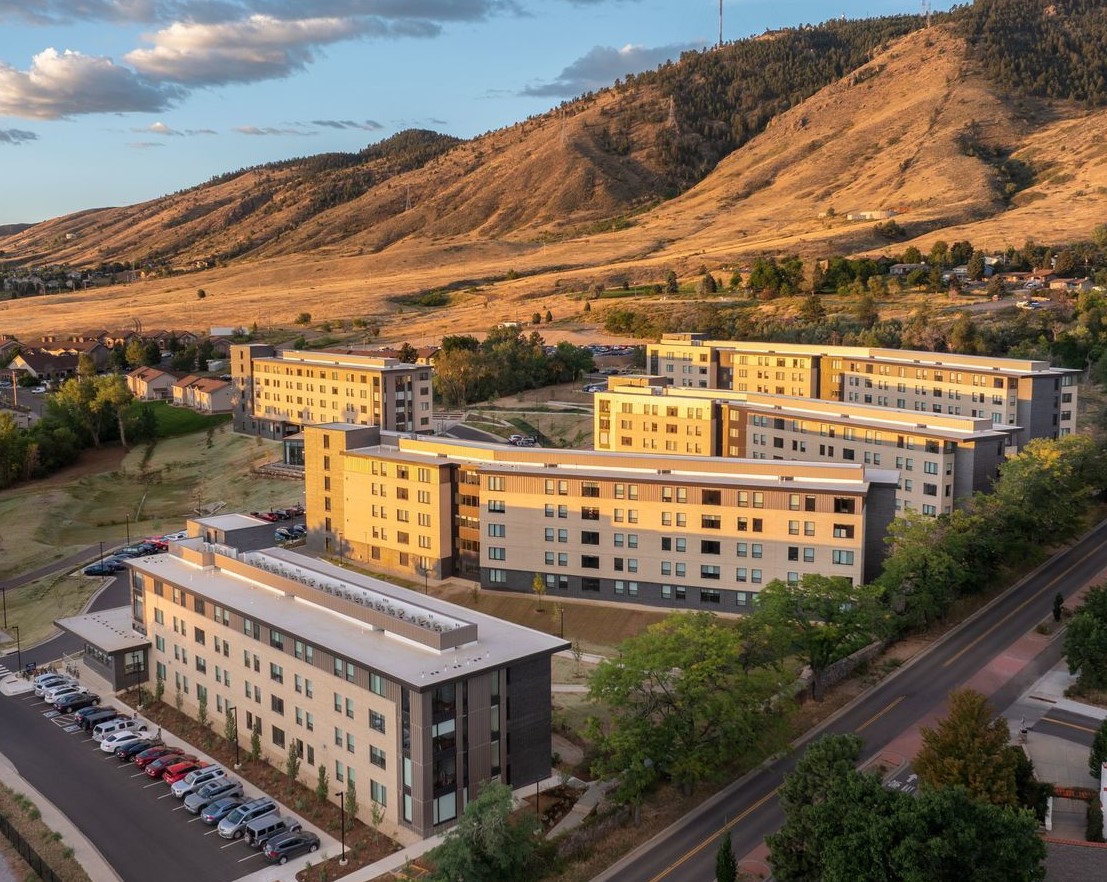
SAR+ Architects / Fortis Structural / Millender White Construction
Hybrid mass timber/light-frame wood student housing includes Types III-B, V-A, and I-A construction across four and five-story buildings
Photo: Kyle Chambers
References are to the 2024 International Building Code (IBC) unless otherwise noted.
Fire and Life Safety: Assessing Risk
The IBC is guided by the principle of designing for fire and life safety based on the theory of equivalent risk. In other words, the code assesses the potential risk of each building and prescribes an appropriate minimum level of protection. Occupancy classifications (Chapter 3) help identify the risks associated with the building’s use while construction types (Chapter 6) and their associated FRRs establish, in part, different levels of fire safety. Allowable building sizes (Chapter 5) aim to balance these levels of risk and safety by limiting building heights and floor areas.
Occupancies with a higher risk generally have smaller allowable building sizes, while larger buildings are allowed for lower-risk occupancies. For example, in an office occupancy (Group B), most people in the building are expected to be alert and mobile, allowing them to evacuate more quickly than those in a residential occupancy (e.g., R-2), who may be asleep. The allowable building sizes in Chapter 5 balance the difference in risk between these occupancies by allowing larger buildings for business occupancies than residential within each construction type. As another example, consider assembly occupancies (A), which are associated with a higher density of people and longer egress times, versus low-hazard industrial facilities (F-1) that are sparsely populated; assembly occupancies often have smaller allowable building sizes while factories can be much larger.
Similarly, construction types with more stringent limitations on the types of materials that can be used and higher FRR requirements (i.e., higher levels of fire safety) are generally allowed to be taller and larger. On the other hand, construction types that are more lenient in terms of materials and FRRs generally have smaller allowable building sizes.
Additional fire and life safety provisions are included throughout the IBC, such as egress requirements, fire protection and life safety systems (e.g., sprinklers, fire alarms, etc.), and additional FRR requirements. While not addressed explicitly in this paper, they follow a similar pattern; more stringent requirements often apply to higher-risk occupancies and/or fewer fire-resistance requirements.
This paper is intended for design and construction professionals who want to more fully understand the options for using wood structural materials under the IBC. Topics include:
- Allowable uses of wood in Types I, II, III, IV, and V construction
- Fire-resistance rating requirements
- Allowable building size, including unlimited areas and the impact of sprinklers
- Choosing the most appropriate construction type
- Additional WoodWorks resources with code-related content
Related Resources
-
 What is mass timber? Solution Papers
 -
Fire Design of Mass Timber Connections: Requirements and Compliance Strategies Solution Papers
-
Fire Requirements for Mass Timber Elements: Code Applications, Construction Types, and Fire Ratings Solution Papers
-
Wood in Industrial Buildings: Systems, Codes, and Design Opportunities Solution Papers